Tongue and Groove: The Hidden Industry Reshaping How Britain Performs Itself
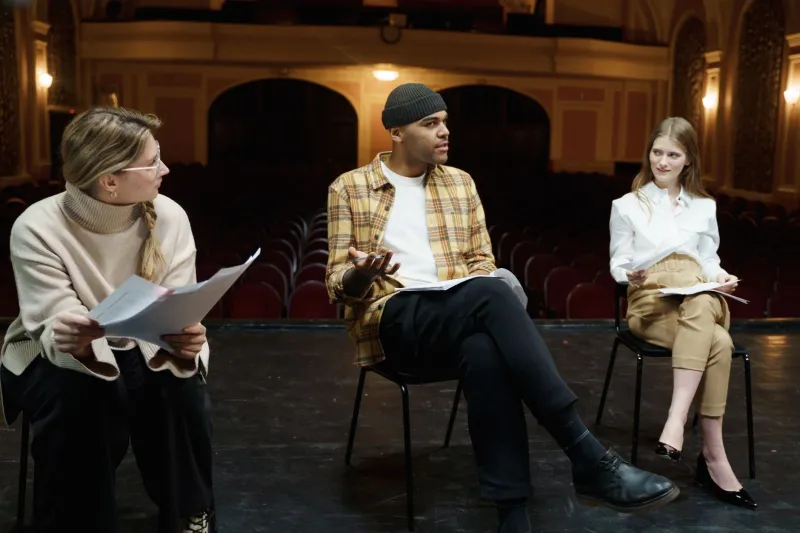
There is a particular irony in watching a Received Pronunciation–trained actor collect awards for their 'transformative' portrayal of a Geordie miner or a Brummie factory worker, their borrowed vowels landing with apparent ease on a West End stage. Somewhere offstage, often uncredited and rarely discussed, sits the person who made that transformation possible. The accent coach. The voice whisperer. The professional architect of other people's mouths.
Britain's accent coaching industry has grown substantially over the past two decades, quietly embedding itself not only in theatre and film production but in corporate boardrooms, legal chambers, and media training suites. It is an industry that rarely advertises itself loudly, and yet its influence on how this country sounds — in its most visible, most celebrated cultural spaces — is profound.
The Shape of a Voice
To understand what accent coaches do, one must first understand what they are asked to undo. The British class system has always encoded itself in speech. From the elocution lessons imposed on grammar school children in the mid-twentieth century to the persistent association of Estuary English with credibility in broadcast journalism, the relationship between accent and social mobility is not merely anecdotal. It is structural.
Voice coaches working in the performing arts broadly divide their practice into two streams: accent acquisition, in which a performer learns to speak convincingly in a register not their own, and what practitioners often call 'neutral voice' work — a euphemism, critics argue, for the gentle flattening of regional specificity into something more palatably universal. That universal, it hardly needs stating, tends to sound a great deal like the Home Counties.
The Royal Academy of Dramatic Art, LAMDA, and the Guildhall School of Music and Drama have all, at various points, been scrutinised for the degree to which their training implicitly or explicitly privileges standardised Southern English speech. Alumni from working-class or regional backgrounds frequently describe a subtle but persistent pressure to 'clean up' their accent — not through overt instruction, but through the accumulated weight of casting assumptions, tutor feedback, and the unspoken grammar of what a leading actor is presumed to sound like.
 Photo: Guildhall School of Music and Drama, via www.gsmd.ac.uk
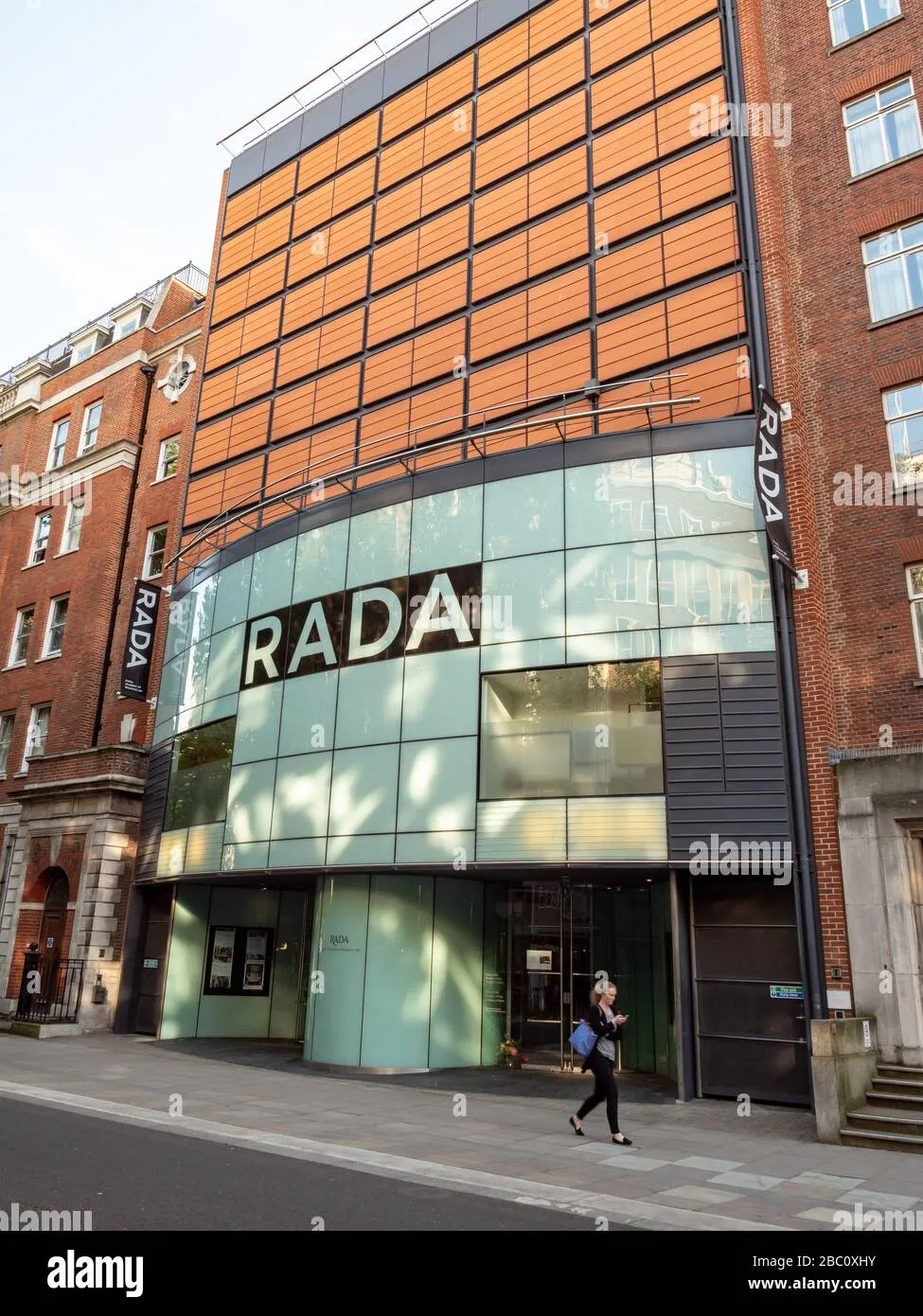 Photo: Royal Academy of Dramatic Art, via c8.alamy.com
Hired to Erase
The market for accent coaching is, in one sense, entirely neutral. Actors need to perform convincingly across a range of registers; coaches provide the technical means to do so. A Scottish actor preparing to play Henry V requires the same professional support as a Received Pronunciation speaker cast as a Liverpool docker. The transaction appears symmetrical.
But it is not symmetrical. The directionality of accent coaching in British performance culture runs, with remarkable consistency, in one direction: regional voices are coached towards legibility within a Southern English framework, while Southern English speakers are coached towards regional voices as an act of creative stretching. The former is survival strategy; the latter is artistic adventure.
This asymmetry is not lost on working practitioners. Several coaches, speaking to Crossed Lines on condition of anonymity, described the discomfort of being hired by productions whose casting decisions had already foreclosed the possibility of authentic regional representation. 'You're essentially being asked to manufacture something that could have simply been cast,' one coach explained. 'There's a moment where you realise the brief isn't really about performance quality. It's about making an uncomfortable choice look seamless.'
The Authenticity Paradox
The debate around accent authenticity has intensified considerably in the wake of broader conversations about representation in the arts. When the question of who gets to play working-class characters collides with the question of how those characters should sound, the accent coach becomes an unwilling focal point in a much larger argument.
Proponents of the craft argue, reasonably, that performance has always involved transformation, and that policing the boundaries of vocal authenticity risks a reductive essentialism — the idea that only those born into a particular community can voice it. This is a legitimate artistic concern. Theatre and literature have always depended on the imaginative capacity to inhabit lives not one's own.
Critics counter that the argument conveniently sidesteps the structural question: if the industry routinely fails to cast actors whose accents are genuinely their own, then the appeal to artistic transformation becomes cover for institutional gatekeeping. The accent coach, in this reading, is not a neutral technician but a symptom of a system that has decided, at the point of casting, that certain voices require professional mediation before they can be heard.
Survival, Betrayal, or Both
For performers from regional or working-class backgrounds, the decision to engage an accent coach — to soften a Scouse edge, to round a Yorkshire flatness — is rarely experienced as straightforwardly ideological. It is experienced as pragmatic. The roles available, the agents who take calls, the productions that offer sustainable careers: all of these apply their own gravitational pull towards a certain kind of voice.
Several actors interviewed for this piece described the process with a mixture of resignation and grief. One, raised in County Durham and trained at a northern conservatoire, recalled being told by an agent early in her career that her accent would 'limit her range' — a phrase that still clearly rankles. 'What they meant,' she said, 'was that it limited their imagination. But you internalise it. You start to hear your own voice as a problem.'
The act of neutralising one's voice can thus be simultaneously an act of survival within an unjust system and an act of complicity in that system's perpetuation. These two things are not mutually exclusive, and the ethical weight of the choice falls, as it so often does, on the individual least responsible for the conditions that necessitate it.
What the Industry Chooses Not to Hear
Britain's performing arts sector has made visible, if uneven, progress in expanding representation across race, gender, and disability. The question of class and regional voice has proven more resistant to reform — perhaps because it touches something particularly raw in the national self-image: the fiction that accent no longer determines destiny, that the playing field has been levelled, that talent alone carries a performer forward.
The accent coaching industry does not create this fiction. But it services it. Every session spent softening a Midlands inflection for a general audition, every hour spent coaching a privately educated actor into a convincing working-class register, is a transaction conducted in the shadow of a cultural hierarchy that has never fully admitted what it is.
The coaches themselves are frequently thoughtful, skilled, and genuinely committed to their performers' wellbeing. The problem is not the practitioners. The problem is the system that tells certain voices they must be processed before they can be heard — and the industry that has built a quiet, profitable, largely unexamined trade around that processing.
Britain's stages, screens, and studios remain places where the lines between performance and erasure run very close together. The accent coach sits precisely at that crossing. What happens there is not simply about vowel sounds. It is about who this country believes deserves to speak, and in whose voice it chooses to recognise itself.