The Window as Manifesto: What Britain's Independent Bookshops Are Actually Saying
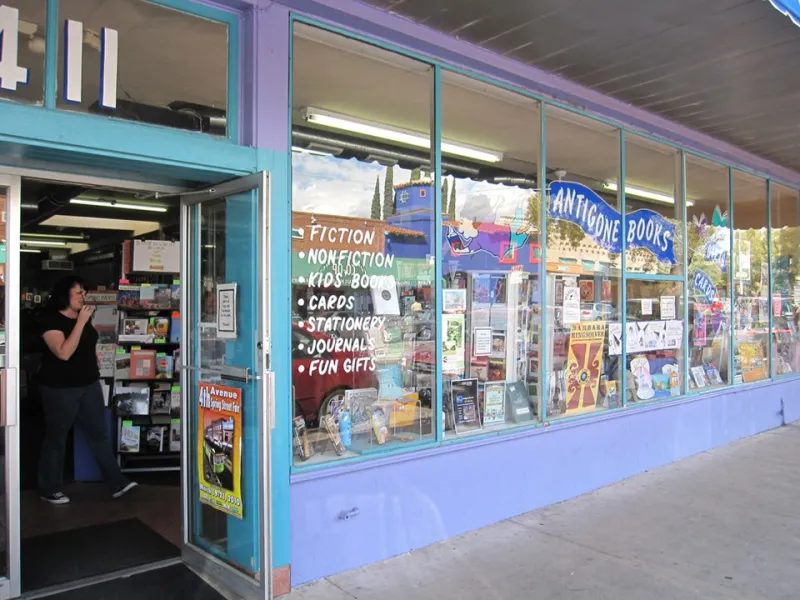
Photo: InSapphoWeTrust from Los Angeles, California, USA, CC BY-SA 2.0, via Wikimedia Commons
The Window as Manifesto: What Britain's Independent Bookshops Are Actually Saying
Somewhere in Edinburgh's Southside, a bookshop has arranged its window around the theme of displacement. The titles — a mix of contemporary fiction, memoir, and translated poetry — are not labelled as such; there is no explanatory card announcing a curatorial concept. But the conversation between them is unmistakable to anyone who pauses long enough to read it. This is not an accident. It is an editorial decision, made by a single person, expressed in the only public-facing space available to them, addressed to whoever happens to be walking past.
This is what Britain's independent bookshop windows do, and have always done, though we rarely stop to consider it. They speak. Not with the algorithmic confidence of a recommendation engine trained on millions of purchasing decisions, nor with the commercial bluntness of a superstore's three-for-two promotion. They speak in the more hesitant, more personal, and ultimately more interesting register of genuine editorial conviction — the voice of someone who has read these books, thought about them, and decided that this particular moment, in this particular place, is when they need to be seen together.
The Last Personal Editorial Act
The decline of the independent bookshop has been documented so extensively, and mourned so loudly, that it risks becoming a cultural cliché. And yet the shops that have survived — and there are more of them than the elegiac narrative sometimes acknowledges, with the Booksellers Association reporting a modest but meaningful growth in independent openings over the past five years — have survived in part because they offer something that no digital platform can replicate: a physical, local, embodied editorial perspective.
The window display is the sharpest expression of that perspective. Unlike the shop's interior, which must balance commercial necessity against personal taste, the window is genuinely curated in the art-historical sense: selected, arranged, and presented according to a coherent, if often implicit, argument about what matters right now. Walk the length of any British high street that retains an independent bookseller and you are walking past a sequence of such arguments, each one calibrated to its particular community.
In Bristol's Stokes Croft, a shop whose window has been a reliable indicator of local political temperature for years arranges its displays in explicit response to national events — books on housing policy appearing the week after a planning controversy, climate writing clustering around protest actions. In a market town in Shropshire, a different shop speaks a different dialect: local history sits alongside countryside memoir, the window a quiet argument for the value of the particular and the rooted against the homogenising pressure of the national. Neither is more legitimate than the other. Both are, in their way, manifestos.
Reading the Hand-Lettered Card
The hand-lettered shelf card — that modest rectangle of folded card on which a bookseller has written a personal recommendation — deserves recognition as a minor literary form in its own right. Its constraints are severe: a few square inches of space, a single sentence or two at most, and the requirement to say something that will make a stranger want to spend money on a book they have never heard of. The best of them are miniature works of persuasive prose, deploying economy and specificity in proportions that most professional blurb writers never quite achieve.
'I read this twice in a week and neither time was enough' is a sentence that will sell books. So is 'If you've ever felt like the only person who sees things a certain way, this is for you.' These are not marketing slogans generated by a committee. They are personal testimony, offered in the full knowledge that the person who wrote them will be judged by whether they are right. The bookseller who recommends badly loses something more than a sale — they lose the trust that makes their editorial voice worth listening to.
This accountability is what distinguishes the independent bookshop's curatorial act from almost every other form of cultural recommendation available to the British consumer. The algorithm is not accountable to you. The superstore buyer is accountable to a spreadsheet. The bookseller who has hand-lettered a card and placed it in a window is accountable, in the most direct possible way, to the community that walks past every day.
Local Identity and the Politics of Arrangement
The political dimensions of the bookshop window are rarely announced but almost always present. In the weeks following the 2016 referendum, several independent booksellers across the country reported that their window arrangements became, without deliberate planning, implicitly or explicitly political — books on European identity, immigration, and democratic history appearing with a frequency that reflected the booksellers' own anxieties and, they found, those of their customers.
More recently, windows have registered the temperature of conversations around race, gender, and economic inequality with a consistency that no single data point can capture but that, taken together across dozens of shops and hundreds of weeks, constitutes something like a distributed literary barometer. The books that appear in independent windows are not merely the books that are selling; they are the books that booksellers believe should be selling, the books they are actively pressing into the cultural conversation.
This distinction matters enormously. The bestseller chart tells you what Britain is buying. The independent bookshop window tells you what at least one thoughtful, locally embedded reader thinks Britain needs to be reading. The two lists overlap, but they are not the same list, and the gap between them is where the most interesting cultural work gets done.
Against Homogeneity
To walk into a Waterstones — a chain that has, it should be said, improved considerably in its attention to local curation — is to encounter a version of Britain's literary culture as seen from a central buying office. To walk into an independent is to encounter it as seen from a particular street, in a particular town, by a particular person who has lived there long enough to know what their neighbours are worried about.
The distinction between these two experiences is not trivial. Culture that is genuinely local — that reflects the specific anxieties, histories, and preoccupations of a specific place — performs a social function that nationally standardised culture cannot. It tells a community something about itself. It creates the conditions for recognition: the small, significant shock of seeing your own experience reflected back at you from a window you pass every morning.
Britain's independent bookshops are not, of course, free from their own blind spots and biases. The sector remains disproportionately white, disproportionately middle-class, and concentrated in areas of sufficient affluence to sustain discretionary book-buying. These are real limitations, and the most thoughtful booksellers are aware of them.
But the window, for all its imperfections, remains one of the few spaces in contemporary British public life where a single person's genuine literary and political convictions are expressed without mediation, without algorithmic interference, and without corporate oversight. In an era when so much of our cultural experience arrives pre-filtered and pre-approved, that stubbornly personal act of arrangement — this book here, next to that one, with this card in the bookseller's own handwriting — is more radical than it looks.