An Orderly Fiction: The Quiet Violence of Britain's Queuing Mythology
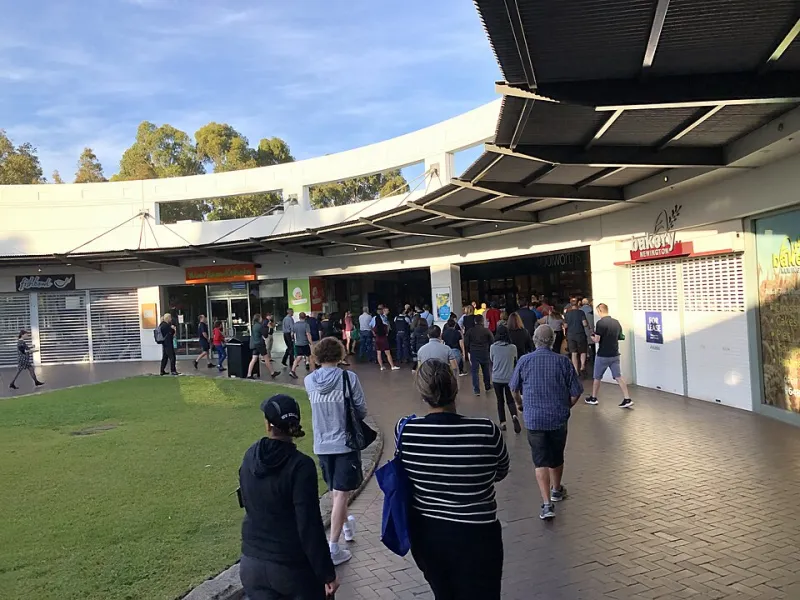
Photo: Simon_sees from Australia, CC BY 2.0, via Wikimedia Commons
An Orderly Fiction: The Quiet Violence of Britain's Queuing Mythology
Let us begin with the mythology, because the mythology is doing a great deal of work. The British queue is, in the national imagination, a form of secular virtue. It is frequently cited — by politicians, by travel writers, by people defending the country to sceptical foreigners at dinner parties — as evidence of something essentially decent about the British character. We wait our turn. We do not push. We observe an unwritten contract of collective patience that speaks, the argument goes, to a deep civic instinct.
This is a very comforting story. It is also, on close examination, almost entirely fiction.
The Performance of Patience
The queue is not, and has never been, a neutral social technology. It is a performance — and like all performances, it has a script, a set of unspoken stage directions, and a very clear sense of who the audience is. The dramaturgical lens, first applied to everyday social behaviour by sociologist Erving Goffman, is nowhere more illuminating than here. To join a queue in Britain is to enter a highly codified ritual in which the appearance of equality masks a complex negotiation of status, entitlement, and belonging.
Consider the vocabulary alone. We do not merely wait; we queue. The verb itself carries moral weight — it implies not just physical positioning but a kind of ethical alignment, a willingness to submit to the collective. To jump a queue is not simply rude; it is, in the British social lexicon, a form of moral transgression roughly equivalent to lying under oath. The language of the queue is the language of civic virtue, and it is deployed with considerable force against those perceived to have violated it.
Yet who decides what constitutes a queue? Who defines its boundaries, its rules of precedence, its acceptable exceptions? This is where the mythology begins to develop cracks.
Glastonbury and the Grammar of Privilege
Few spectacles illuminate the class politics of queuing more vividly than the annual scramble for Glastonbury Festival tickets. The official queue — the online waiting room, refreshed obsessively on multiple devices by those fortunate enough to have reliable broadband and the leisure to spend a morning doing so — is presented as democratic. Everyone waits together. Everyone has an equal chance.
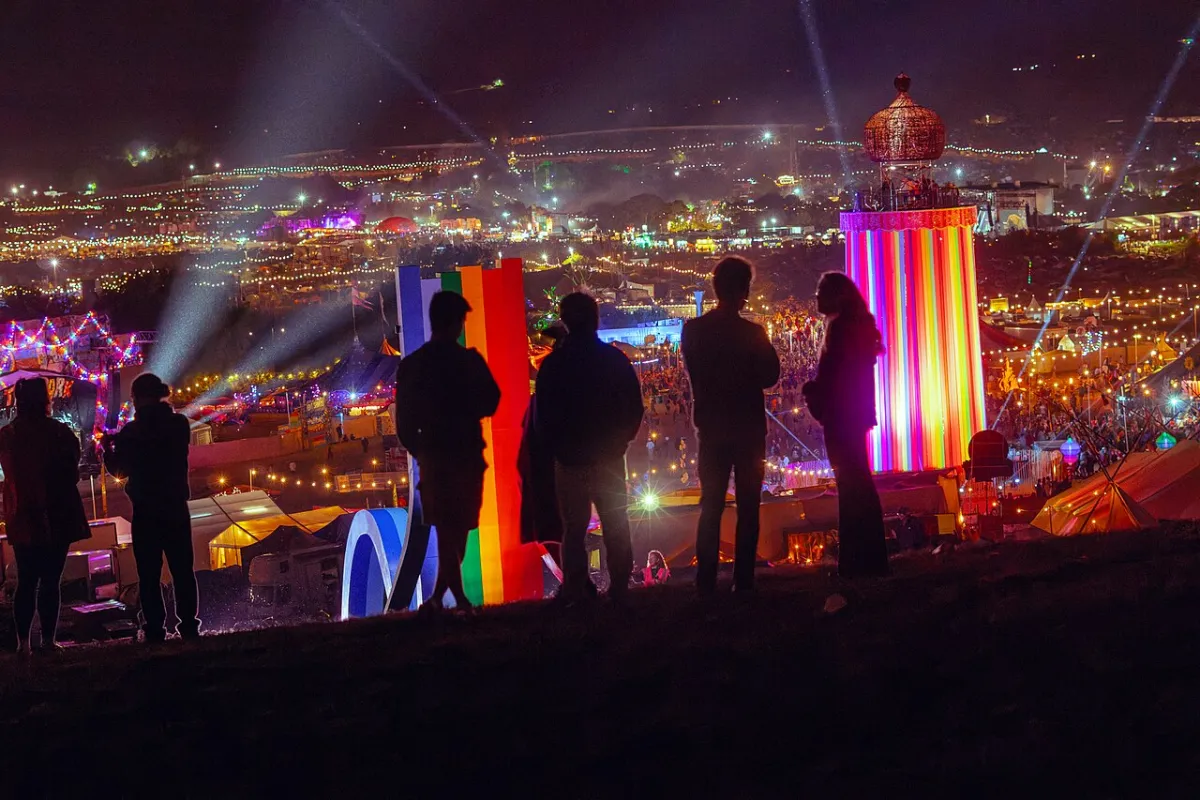 Photo: Glastonbury Festival, via upload.wikimedia.org
Except that they do not. The ability to queue effectively for Glastonbury tickets requires time, technology, and the kind of domestic flexibility that is unevenly distributed across the population. It requires a home with fast internet, or an employer tolerant of a morning's distraction, or simply the prior knowledge that the sale is happening at all — knowledge that circulates most reliably through networks of cultural insiderness. The queue is nominally open to everyone. Its conditions of access are not.
This pattern recurs throughout British cultural life. The West End box office queue — still maintained as a romantic institution even as most transactions move online — has its own internal hierarchies. Those who arrive earliest, who know which shows release day-seats and when, who understand the unwritten etiquette of the pavement vigil, are not randomly distributed across the population. They are disproportionately young, educated, and already embedded in the cultural economy of the capital. The queue rewards cultural capital as surely as it rewards physical endurance.
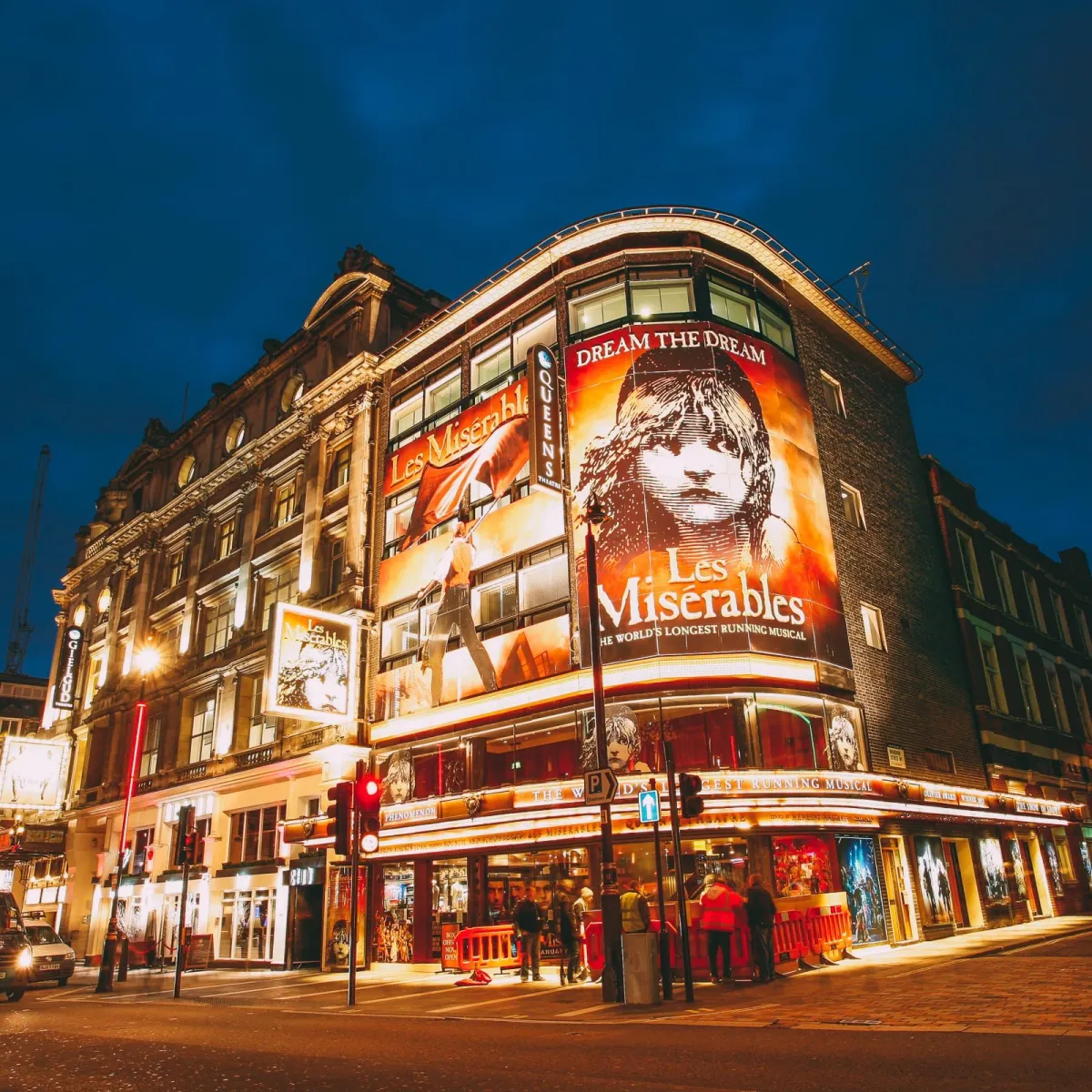 Photo: West End, via i.pinimg.com
The NHS Waiting Room as National Text
If the Glastonbury queue is a spectacle of aspiration, the NHS waiting room is something altogether more revealing. It is, in a sense, the queue at its most ideologically honest: a space where the principle of equal waiting is enshrined in the founding architecture of the institution, and where that principle is tested, daily, against the realities of a stratified society.
Sitting in an NHS waiting room is, for many British people, a rare experience of enforced proximity with those whose lives ordinarily run on entirely different tracks. The solicitor and the shelf-stacker share the same plastic chair, the same fluorescent light, the same dog-eared magazines. This is sometimes cited, sentimentally, as evidence of the NHS's democratic genius. But the waiting room also encodes its own hierarchies — in who has a GP at all, in who can afford to take time off work to attend, in who navigates the appointment system with ease and who falls through its administrative gaps.
Literature has always known this. From the waiting rooms of Kafka to the surgeries of Alan Bennett's work, the space of enforced waiting has served as a pressure cooker for social anxiety, a place where the fiction of equal treatment meets the reality of unequal circumstance. Bennett's patients, in particular, carry with them the full weight of class performance: the careful maintenance of dignity in undignified circumstances, the excruciating awareness of being observed while vulnerable.
Queue Rage and the Limits of Decorum
The frequency with which queuing norms break down is itself instructive. Queue rage — that specifically British phenomenon in which the transgression of waiting etiquette provokes a fury wildly disproportionate to the offence — is not simply bad temper. It is the symptom of a social contract under pressure. When someone pushes in, they are not merely taking a physical position; they are, in the symbolic grammar of British public life, declaring themselves exempt from the rules that bind everyone else. The rage this provokes is the rage of a mythology threatened.
Recent years have produced flashpoints that illuminate this with unusual clarity. The scenes at petrol stations during the 2021 supply crisis, the confrontations at supermarket self-checkouts, the simmering tensions at airport security queues — each of these revealed, briefly and uncomfortably, how thin the veneer of collective decency actually is. The queue holds, until it doesn't. And when it doesn't, what is exposed is not aberration but substrate.
Rewriting the National Script
To dismantle the queue as national virtue is not to argue for chaos. It is to argue for honesty. The queue is a social technology, and like all social technologies it reflects the values of those who designed it and the conditions of those who use it. Treating it as a straightforward expression of collective decency obscures the ways in which it reproduces, rather than dissolves, the inequalities it appears to neutralise.
Britain's writers have occasionally sensed this. Zadie Smith's crowd scenes, Ali Smith's attentive renderings of public space, even the quiet social archaeology of a David Nicholls novel — these works understand that the spaces where strangers are forced into proximity are the spaces where the national self-image is most visibly under negotiation.
The queue is not a canvas on which Britain's best values are displayed. It is a stage on which its contradictions are performed, nightly, with remarkable discipline. Understanding it as such is not pessimism. It is the beginning of a more honest conversation about what fairness might actually require — and who has been waiting longest to have it.