Between the Shelves and the Sofa: How Bookshops Became Britain's Unofficial Counselling Rooms

Between the Shelves and the Sofa: How Bookshops Became Britain's Unofficial Counselling Rooms
There is a particular quality of light in a well-kept independent bookshop — something between sanctuary and sitting room, neither entirely public nor quite private. It is precisely this ambiguity that has allowed a quiet transformation to unfold on Britain's high streets. In towns from Totnes to Tynemouth, booksellers are assembling dedicated sections devoted to bereavement, anxiety, divorce, chronic illness, and the jagged edges of human experience that resist easy categorisation. They are doing so without fanfare, without clinical qualification, and — crucially — without any clear consensus about whether they should.
This is not merely a merchandising trend. It is a cultural phenomenon that speaks directly to the fault lines running through contemporary British life: the erosion of statutory mental health provision, the atomisation of community, and the enduring, perhaps irrational, faith that the right book at the right moment can do something that even the most attentive GP cannot.
The Architecture of Empathy
Walk into Mr B's Emporium of Reading Delights in Bath, or the much-loved Forum Books in Corbridge, and you will find these sections positioned with evident care. They are rarely near the entrance — that would feel presumptuous — and seldom tucked away in a forgotten corner. Instead, they occupy a considered middle distance: accessible without being intrusive, prominent without being performative. The shelves themselves carry a particular grammar. Titles on grief sit beside memoirs of recovery; poetry collections on loss neighbour practical guides to navigating probate. The arrangement implies a kind of emotional journey, a narrative arc from rupture towards — if not resolution — at least endurance.
 Photo: Forum Books, via www.thebooktrail.com
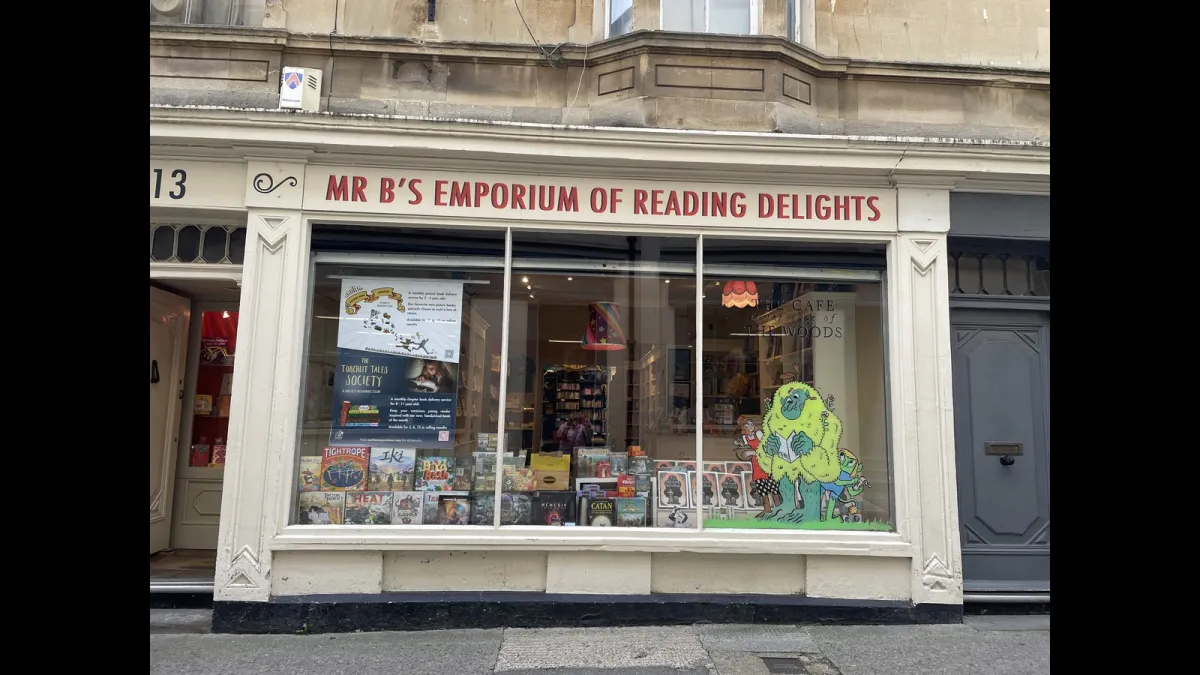 Photo: Mr B's Emporium of Reading Delights, via www.hindustantimes.com
Booksellers who have built these sections speak about the process with a mixture of conviction and uncertainty. Many describe discovering the need organically: a customer asking, with barely concealed desperation, whether there was anything on losing a parent; a teenager lingering near the psychology shelves without quite knowing what they were looking for. The section, in many cases, preceded any deliberate policy. It grew because the need was already there, pressing itself quietly against the glass.
Commerce and Vulnerability
Yet the ethical complexity here deserves honest examination rather than comfortable celebration. Independent bookshops are businesses. They operate on margins that would make most retailers weep, and a well-positioned grief section is, among other things, a sound commercial proposition. The bibliotherapy movement — which has gained considerable traction in Britain over the past decade, partly through the work of organisations such as The School of Life and the initiatives of individual booksellers — has demonstrated that readers will spend meaningfully on books that promise emotional utility. To acknowledge this is not cynicism; it is intellectual honesty.
The more troubling question is what happens at the moment of transaction. A bookseller recommending a title on complicated grief to a recently bereaved customer is performing a role that carries genuine emotional weight. They are not trained counsellors. They have not conducted a needs assessment. They cannot follow up. And yet, in the absence of accessible talking therapies — with NHS waiting lists for psychological support stretching, in some areas, beyond eighteen months — the bookshop has become, by default, a first port of call. The bookseller becomes an accidental frontline worker, absorbing distress and offering what comfort they can in the form of a carefully chosen paperback.
Several booksellers have spoken candidly about the toll this takes. The conversation that begins with a book recommendation and ends, forty minutes later, with a stranger's tears is not unusual. Nor is the creeping anxiety about whether one has said the right thing, recommended the right title, or — more pressingly — missed something that required a different kind of intervention entirely.
What the Shelf Reveals About Britain
There is something distinctly, perhaps uniquely, British about seeking emotional support through the medium of a book purchase. The transaction provides cover — one is, after all, merely shopping — whilst simultaneously enabling a form of disclosure that might prove impossible in a more explicitly therapeutic context. The bookshop does not require an appointment, a referral, or the admission that one is struggling. It simply requires the willingness to walk through a door.
This cultural preference for the oblique, for approaching vulnerability sideways rather than head-on, is itself worthy of literary analysis. Britain has long maintained a complicated relationship with emotional directness, and the grief shelf may be read as a physical manifestation of that ambivalence: an acknowledgement that help is needed, encoded in the language of retail.
There is also a class dimension that warrants attention. The independent bookshops pioneering these sections tend to cluster in university towns, market towns, and the more prosperous quarters of larger cities. They serve, broadly, an educated, middle-class clientele already disposed to the idea that reading is a legitimate form of self-care. Whether this model reaches the communities most acutely underserved by mental health provision — rural isolation, post-industrial towns, areas of concentrated deprivation — is a question that the movement's more enthusiastic advocates have not yet answered satisfactorily.
The Ethics of the Curated Shelf
Not all titles on bereavement are equal. Some are grounded in robust psychological research; others traffic in comforting platitudes that may, in certain circumstances, actively impede the work of grieving. The bookseller who curates a grief section is making editorial judgements with real consequences, and without the professional framework that would ordinarily govern such recommendations. A poorly chosen book on suicide bereavement, for instance, could cause genuine harm. The responsibility is not hypothetical.
Some shops have responded to this by establishing informal relationships with local counsellors and therapists, creating referral networks that acknowledge the limits of what a book can do. Others have begun hosting events — author readings, discussion evenings — that create space for conversation within the relative safety of a communal setting. These are thoughtful adaptations, but they remain ad hoc, unregulated, and entirely dependent on the individual bookseller's instinct and initiative.
A Line Worth Crossing
None of this is to argue that the grief shelf should not exist. On the contrary: in a cultural landscape where emotional literacy is still too often treated as a luxury rather than a necessity, the willingness of independent booksellers to hold space for life's harder chapters represents something genuinely valuable. The best of these sections are not pretending to be therapy; they are offering something different — the companionship of other voices, the recognition that one's suffering has been articulated before and survived.
But the phenomenon also asks us to confront an uncomfortable truth about the state of Britain's social infrastructure. When bookshops fill the gaps left by underfunded public services, we should feel gratitude and unease in equal measure. The shelf is a kindness. The conditions that made it necessary are not.
The crossed line here — between commerce and care, between retail and remedy — is one that Britain's booksellers are navigating with more grace than the situation perhaps deserves. What they cannot do is resolve the underlying contradiction. That work belongs elsewhere.