Threshold Politics: How Britain's Theatre Foyers Stage Class Before the Curtain Rises
Architecture as Ideology
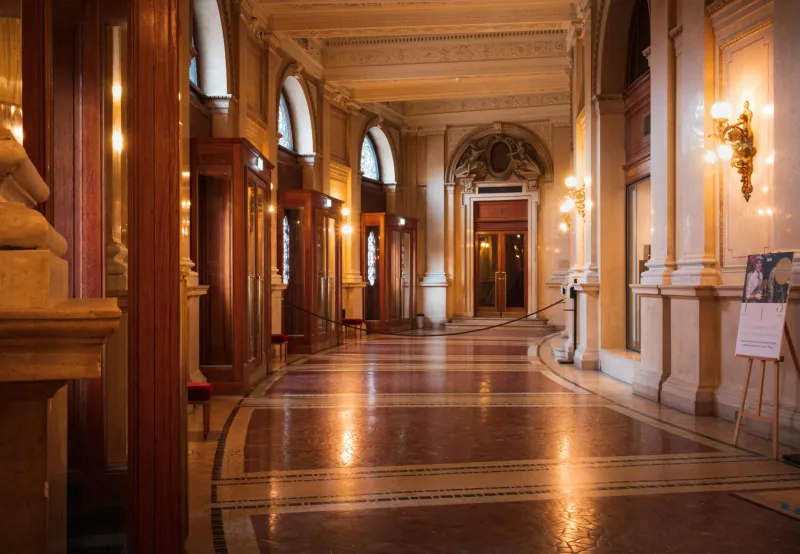
The moment you cross the threshold of the National Theatre's brutalist foyer, you enter a carefully orchestrated social experiment. The concrete expanses and geometric severity announce serious artistic intent, whilst the multiple levels and confusing signage subtly test visitors' cultural confidence. This is architecture as ideology — a physical manifestation of the institution's relationship with its public that speaks volumes before any actor takes the stage.
 Photo: National Theatre, via img.freepik.com
Britain's theatre foyers function as more than mere waiting rooms; they are sophisticated instruments of social sorting. Through design choices both deliberate and unconscious, these spaces communicate who belongs, who is welcome, and who might feel more comfortable leaving during the interval. The foyer is where theatre's democratic aspirations meet its elitist instincts, and the tension is written in marble and mahogany.
The Semiotics of Space
Consider the contrasts: the Royal Opera House's champagne bar, with its gilt mirrors and crystal chandeliers, versus the Young Vic's deliberately casual café space with mismatched furniture and exposed brick. Each design choice carries ideological weight. The Opera House's grandeur signals cultural importance and social elevation; the Young Vic's studied informality suggests accessibility and contemporary relevance. Yet both strategies can exclude — one through intimidation, the other through a different kind of cultural coding that requires visitors to understand the signifiers of 'authentic' artistic experience.
 Photo: Royal Opera House, via www.piatraonline.ro
These design decisions reflect what sociologist Pierre Bourdieu identified as 'cultural capital' — the unspoken knowledge that determines social positioning. Theatre foyers become spaces where this capital is both displayed and accumulated. The confident navigation of multiple bar areas, the casual discussion of previous productions, the appropriate dress codes — all these behaviours mark insiders from outsiders with surgical precision.
The Economics of Belonging
Nothing reveals a theatre's true relationship with its audience quite like the interval pricing structure. At the Barbican, a glass of house wine costs £8.50 — more than many audience members paid for their entire ticket through subsidised schemes. This pricing creates a two-tier experience: those who can afford to socialise in the foyer and those who remain in their seats, excluded from the social ritual that traditionally accompanies theatre-going.
The economics extend beyond individual transactions to institutional strategy. Foyer revenues often subsidise ticket prices, creating a system where the wealthy effectively fund access for others through their consumption of overpriced refreshments. This Robin Hood economics operates invisibly, allowing institutions to maintain the fiction of accessibility whilst relying on exclusionary practices to generate revenue.
Recent renovations have attempted to address these contradictions with mixed success. The Old Vic's 2019 refurbishment introduced multiple price points and casual seating areas, yet critics noted that the 'democratised' space simply created new hierarchies — between those who could afford table service and those relegated to standing areas.
Codes and Performances
The foyer is where theatre's unspoken dress codes play out most obviously. Despite official policies welcoming all attire, subtle pressure remains for audiences to 'dress up' for the theatre. This expectation particularly affects working-class audiences, for whom formal clothing represents additional expense and potential discomfort. The result is a form of soft gatekeeping that operates through social pressure rather than explicit rules.
Observational studies reveal the complex choreography of foyer behaviour. Regular attenders demonstrate their insider status through confident navigation of space and casual interaction with staff. First-time visitors often cluster near entrances, uncertain of protocols and reluctant to claim space. The foyer becomes a stage where cultural belonging is performed through seemingly natural behaviours that actually require significant social learning.
The Interval Divide
The twenty-minute interval transforms the foyer into a microcosm of British class dynamics. Social groups self-segregate by age, dress, and confidence level. The champagne drinkers gather near the bar; families with children gravitate toward quieter corners; young audiences often retreat outside entirely, excluded by both pricing and atmosphere.
This segregation has practical consequences for the theatrical experience. Conversations overheard in foyers often influence audience interpretation of performances, creating informal critical communities that shape reception. Those excluded from foyer socialisation miss this collective meaning-making process, experiencing theatre as individual consumption rather than communal interpretation.
Designing Democracy
Some institutions have recognised the foyer's ideological function and attempted reform. The Everyman Liverpool's 2014 reconstruction deliberately blurred boundaries between auditorium and foyer, creating flowing spaces that discourage hierarchical separation. The theatre's management explicitly acknowledged the political dimensions of architectural choice, designing spaces that would 'break down barriers between performers and audiences, and between different types of audience members.'
Yet even well-intentioned redesigns can reproduce exclusion through different mechanisms. The Everyman's open-plan design, whilst more democratic in theory, requires visitors to possess the social confidence to occupy flexible space appropriately. The elimination of clear boundaries can paradoxically increase anxiety for those uncertain of social codes.
Beyond the Threshold
The challenge facing British theatre is whether genuine democratisation is possible within existing institutional frameworks. Foyer design reflects deeper questions about cultural value and accessibility that cannot be resolved through architectural solutions alone. The spaces we create inevitably embody the values we hold, whether consciously articulated or unconsciously assumed.
As arts funding faces continued pressure and audiences become increasingly diverse, foyers will likely become even more significant as spaces where institutional identity is negotiated. The question is whether British theatre will use these transitional spaces to genuinely welcome new audiences or simply create more sophisticated forms of exclusion.
The foyer reveals what mission statements conceal: that cultural democracy remains an aspiration rather than an achievement. Until we acknowledge the political work these spaces perform, Britain's theatres will continue to stage their most important drama before the curtain ever rises — the ongoing performance of who culture is really for.