Rooms Where Time Stops: The NHS Waiting Room as Cultural Mirror
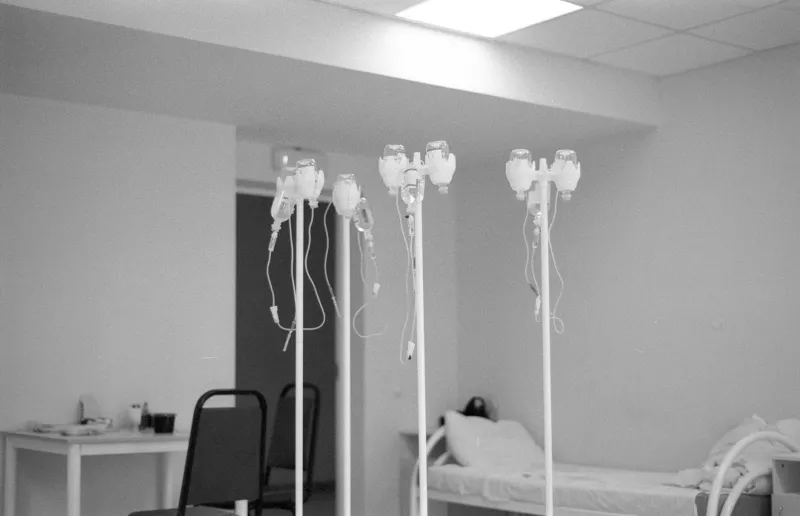
The chairs are invariably blue. Not always the same shade — sometimes a faded teal, sometimes a municipal navy, occasionally a dusty cerulean that has been bleached by decades of fluorescent light into something approaching resignation — but blue, reliably, as though the colour were specified somewhere in the foundational documents of the health service itself. Beside them, on low tables bolted to the floor to prevent rearrangement, sit the magazines: issues of Hello! from several seasons ago, a Which? from the year before last, a puzzle book with most of the puzzles completed in a handwriting that belongs to someone who may or may not still be alive.
This is the NHS waiting room. It is unglamorous, underfunded, and almost entirely unexamined as a cultural space. It is also, I want to argue, one of the most revealing rooms in Britain.
The Democracy of Discomfort
What distinguishes the NHS waiting room from virtually every other public space in British life is its refusal of hierarchy. The private clinic, the members' club, the airport lounge — these are spaces that work hard to sort their occupants, to signal to those inside that they have earned their comfort. The waiting room does the opposite. It assembles its population indiscriminately: the elderly and the young, the employed and the unemployed, those who arrived by taxi and those who walked. It seats them in identical chairs and subjects them to identical uncertainty. The consultant does not, on the whole, keep the wealthy waiting less than the poor.
This democratic character is not accidental. It is structural — a consequence of the founding principle that the health service exists to serve the population as a whole, without distinction of means. The waiting room is where that principle becomes physical, becomes spatial, becomes something you sit inside rather than merely believe in. It is, in this sense, a kind of architecture of political commitment — not beautiful, not comfortable, but honest in a way that few British spaces manage to be.
The philosopher Simone Weil wrote about waiting as a form of attention — a willing suspension of the self's ordinary demands in favour of openness to what is coming. There is something of this in the waiting room, though Weil was probably not imagining the particular quality of attention induced by a three-hour wait for a GP appointment. And yet the enforced stillness of the space does create a peculiar intimacy between strangers. You notice the woman across from you reading the same paragraph repeatedly. You hear the elderly man beside you rehearsing what he is going to say to the doctor. You become, briefly and involuntarily, part of one another's lives.
Artists in the Antechamber
British artists and writers have long intuited the waiting room's peculiar charge. Alan Bennett, whose entire career might be understood as an extended meditation on the dignity of ordinary British lives, returned to the medical waiting room repeatedly — most memorably in his Talking Heads monologues, where the doctor's surgery functions as a site of revelation, a place where the carefully maintained fictions of ordinary life become suddenly permeable.
 Photo: Alan Bennett, via wallpapers.com
The documentary photographer Martin Parr, whose work has spent decades examining the textures of British daily life with a mixture of affection and forensic unease, has produced images of NHS interiors that capture something essential about the relationship between institutional space and human endurance. The peeling health promotion poster, the hand sanitiser dispenser mounted at an angle suggesting hasty afterthought, the window that looks out onto a car park — these are not incidental details but load-bearing elements of a particular kind of British experience.
 Photo: Martin Parr, via static1.srcdn.com
More recently, a number of contemporary photographers and visual artists have turned their attention to NHS interiors with an urgency that reflects the political moment. Projects documenting ward closures, accident and emergency departments at capacity, and the slow material deterioration of hospital infrastructure have appeared in galleries and online platforms with increasing frequency. These are not comfortable images. They are intended to be uncomfortable — to make visible a dilapidation that official discourse prefers to describe as a funding challenge rather than a political choice.
What the Walls Remember
The waiting room accumulates history in the way that only heavily used, rarely renovated spaces can. The notice board is a palimpsest of public health campaigns spanning multiple decades, pinned one over another until the board is several layers deep. The chairs bear the impressions of thousands of bodies. The floor, where the linoleum has not been replaced, carries the scuff marks of anxiety and boredom and relief.
This accumulated material history is, in its way, a form of archive — unofficial, unintended, and all the more revealing for it. The waiting room does not curate itself. It simply receives, and in receiving, it records. The transition from one political era to another is visible in the posters: the confident public health messaging of the early NHS years giving way to the more anxious, target-driven communications of the Blair period, and then to the austerity-era notices that manage to be simultaneously urgent and underfunded.
The novelist Ali Smith, in her Seasonal Quartet, uses the NHS waiting room as one of several spaces where her characters encounter the unmediated reality of contemporary Britain — a place where the abstractions of political debate become flesh, become waiting, become the specific weight of a blue plastic chair. Smith understands, as the best writers of her generation do, that the quality of a society's public spaces is not a peripheral matter. It is a moral one.
 Photo: Ali Smith, via www.si.com
The Room Under Pressure
It would be dishonest to write about the NHS waiting room in 2024 without acknowledging what is happening to it. The spaces themselves are under extraordinary pressure — overcrowded, understaffed, materially deteriorating. The waiting times that have always defined the room's experience have extended to durations that test the metaphor of patient endurance beyond what it can comfortably bear. The democracy of the waiting room, always imperfect, is being further eroded by the growth of private healthcare, which removes those with the means to pay from the shared experience of waiting altogether.
What is lost when this happens is not merely an inconvenience redistributed. It is a form of social knowledge — the knowledge that comes from sitting beside someone whose life is entirely unlike yours and sharing, for an hour or two, the same uncertainty. The waiting room, at its best, has always been a place where Britain's crossed lines converge: where the stories we tell about class and merit and deserving are briefly suspended in favour of a simpler and more honest account of what it is to be human and unwell and in need of help.
When those rooms fall apart, or when those who can afford to leave them do so, something more than a public amenity is diminished. A particular kind of democratic imagination — one that has always been fragile, always contested, always worth defending — becomes harder to sustain.
The blue chairs remain. For now.