Souvenir of Omission: The Ideological Theatre of Britain's Heritage Gift Shop
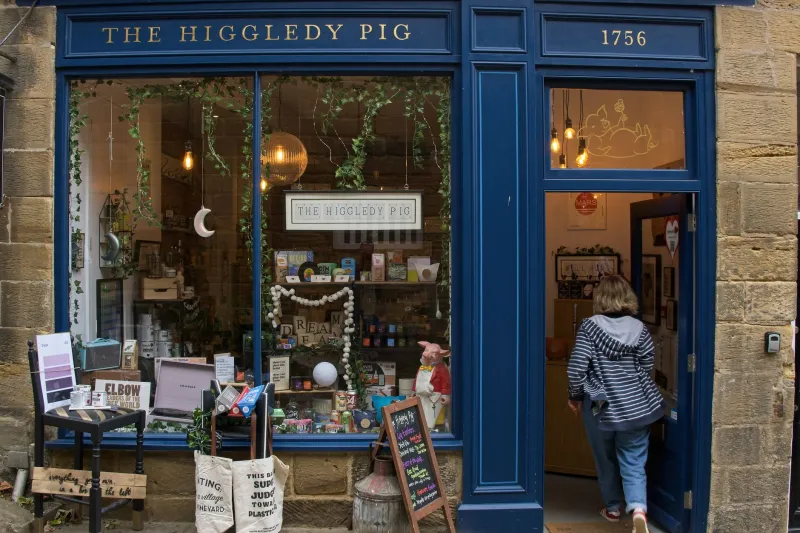
Souvenir of Omission: The Ideological Theatre of Britain's Heritage Gift Shop
The gift shop is where the heritage experience goes to resolve itself. Having moved through rooms of ancestral portraiture, having absorbed the carefully worded panels about architectural restoration and the provenance of silverware, the visitor arrives at last at the threshold between history and commerce — a space that promises, in its arrangement of lavender soap and linen tea towels, a kind of benign conclusion. Nothing difficult happened here. Here, one simply chooses.
Except, of course, that is not quite true. The gift shop at a National Trust property or an English Heritage site is one of the most ideologically loaded spaces in contemporary Britain — precisely because it does not present itself as such. It presents itself as cheerful, accessible, tasteful. It presents itself as the gift shop.
 Photo: National Trust, via nt.global.ssl.fastly.net
What the Shelves Are Selling
Consider what a typical heritage gift shop curates. There will be products bearing William Morris patterns — endlessly reproduced, endlessly purchased, their Arts and Crafts provenance functioning as a shorthand for a particular vision of Englishness that is bucolic, handcrafted, and conspicuously unthreatening. There will be books: house histories written in the warm, anecdotal register of the enthusiast, with period illustrations and genealogical appendices. There will be jams, biscuits, and shortbread in tins bearing the silhouette of the property itself, neatly converting the visit into an edible memory.
What is notably absent, in the majority of cases, is any product that engages with the mechanisms by which the house and its contents were accumulated. The slave-trade wealth that funded the construction of Harewood House in West Yorkshire, the East India Company profits that built Basildon Park in Berkshire — these histories are, at best, gestured at in the interpretive rooms within the house, and almost entirely absent from the retail space that follows. The gift shop, in this sense, is where accountability goes to be quietly retired.
 Photo: Basildon Park, via www.theenglishhome.co.uk
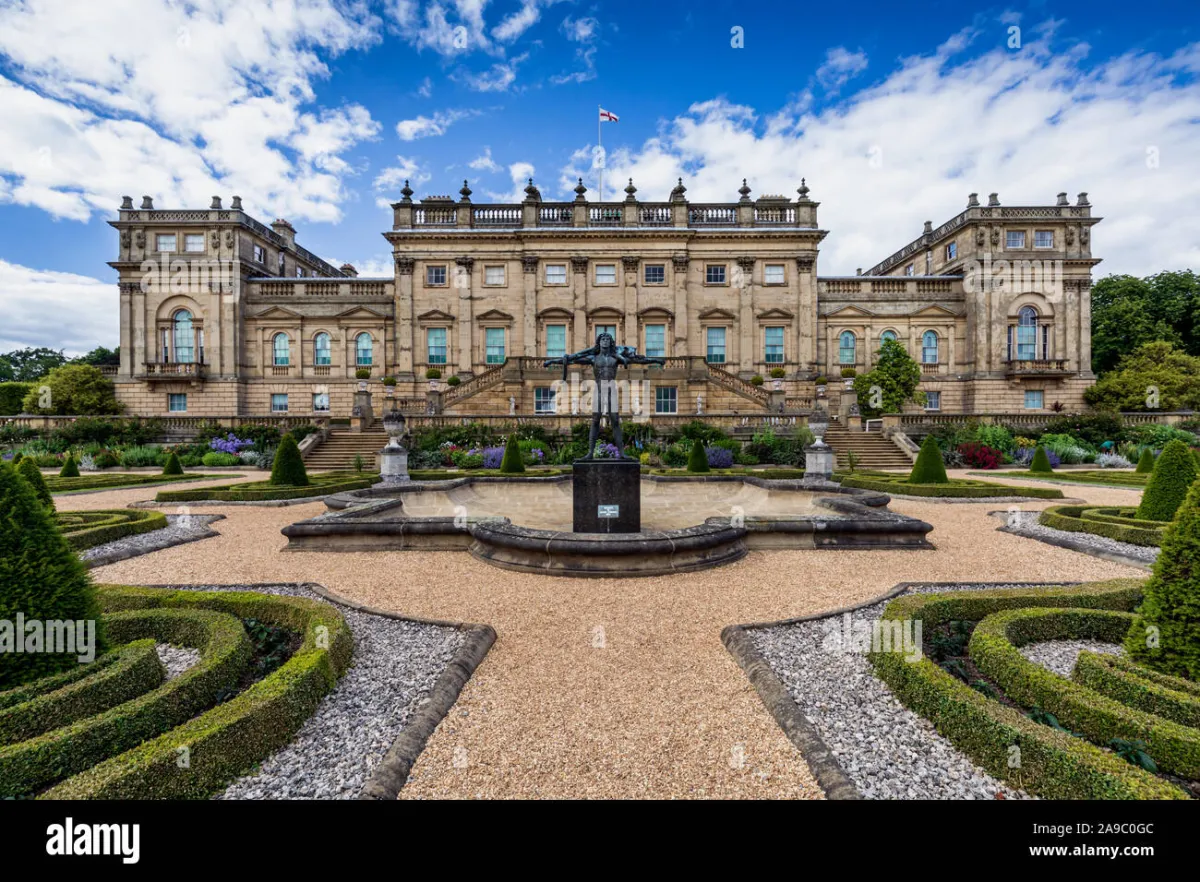 Photo: Harewood House, via c8.alamy.com
This is not a matter of oversight. It is a curatorial choice, and like all curatorial choices, it communicates something about whose stories are considered worth commemorating, and in what form.
The Aesthetics of Selective Memory
The visual language of the heritage gift shop deserves close attention, because it is doing considerable work. The colour palette — creams, sage greens, deep navies — signals quality and restraint. The typography tends towards the classical: serifs that evoke Georgian printing, lettering that implies permanence and authority. The objects themselves are designed to be beautiful, and many of them are. A well-made ceramic mug bearing the crest of a Jacobean manor is a genuinely pleasing thing.
But beauty, in this context, functions as an anaesthetic. The aesthetic coherence of the gift shop creates an emotional environment in which critical thought feels somehow inappropriate — a violation of the mood. To stand before a display of hand-illustrated botanical prints and ask where the money came from to commission the original garden feels, by design, like bad manners. The gift shop has aestheticised its own evasions.
This is not unique to heritage retail, but it is particularly acute here, because the heritage sector trades explicitly in the authority of the past. Its legitimacy depends on the claim that it is preserving and presenting history faithfully. When the gift shop contradicts that claim — by offering a version of history that has been curated for comfort rather than completeness — the institution's foundational promise is quietly broken.
The Tentative Arrival of Accountability
In recent years, and with varying degrees of conviction, some heritage properties have begun to introduce what might be called accountability merchandise: books examining the colonial connections of specific houses, exhibition catalogues accompanying displays on empire and enslavement, and — most tentatively — context cards placed alongside products that have a complicated lineage. The National Trust's 2020 report on colonialism and historic slavery, which linked ninety-three properties to colonial wealth, prompted considerable public debate and, eventually, some modest curatorial changes in the retail spaces of affected properties.
The response from a certain quarter of the British press was predictably hostile. The charge was that heritage organisations were imposing contemporary political frameworks onto the past, traducing the memory of great families and alienating ordinary visitors who simply wanted a pleasant afternoon out. What this critique conspicuously failed to acknowledge was that the existing gift shop had always been political — it had simply been political in a direction that felt, to its defenders, like neutrality.
The introduction of a book about plantation economics into a gift shop that previously stocked only house histories is not the imposition of ideology onto a previously ideology-free space. It is the replacement of one ideological arrangement with a more complete one. The discomfort this provokes is itself revealing.
The Tudor Tea Towel as Text
It would be a mistake to treat the heritage gift shop purely as a site of suppression. It is also, in its way, a form of folk art — a collective act of imagining that tells us a great deal about the Britain that produces and purchases it. The Tudor tea towel, the Regency notebook, the Victorian postal print: these objects represent a sustained cultural investment in particular periods of British history, and that investment is not random.
The periods that sell — and they are remarkably consistent across different properties and organisations — are those associated with a particular fantasy of national coherence: a Britain that was hierarchical but knowable, aesthetically confident, and possessed of clear values. The Georgian interior, the Arts and Crafts garden, the Edwardian country house: these are not simply periods of history but emotional propositions, offering the visitor a version of Britishness that feels stable and legible in a moment when neither quality is especially abundant.
To understand the heritage gift shop fully, one must understand it as a form of cultural longing — and to take that longing seriously rather than simply dismissing it. The question is not whether people should find comfort in the past, but which past, and on whose terms, and at whose expense.
The Most Contested Room in the Building
The gift shop is the last room the visitor enters and the first thing they will tell their friends about. It is where the interpretive experience is converted into a portable object, a tangible residue of the afternoon. In that sense, it is the institution's final editorial statement — its last opportunity to shape what the visitor takes away, literally and figuratively.
As Britain continues to negotiate its relationship with the more troubling chapters of its history, the gift shop will remain one of the more unexpected arenas in which that negotiation plays out. The lavender shortbread is not innocent. The William Morris tote bag is not neutral. Every object on those shelves is an argument about which version of Britain is worth preserving, celebrating, and selling.
The crossed lines here — between commerce and commemoration, between nostalgia and accountability, between the beautiful object and the difficult truth it may be concealing — run directly through the display cases of Britain's most visited rooms. It is time we started reading them.