Pencilled Uprisings: The Secret Intellectual Life of Britain's Annotated Library Books
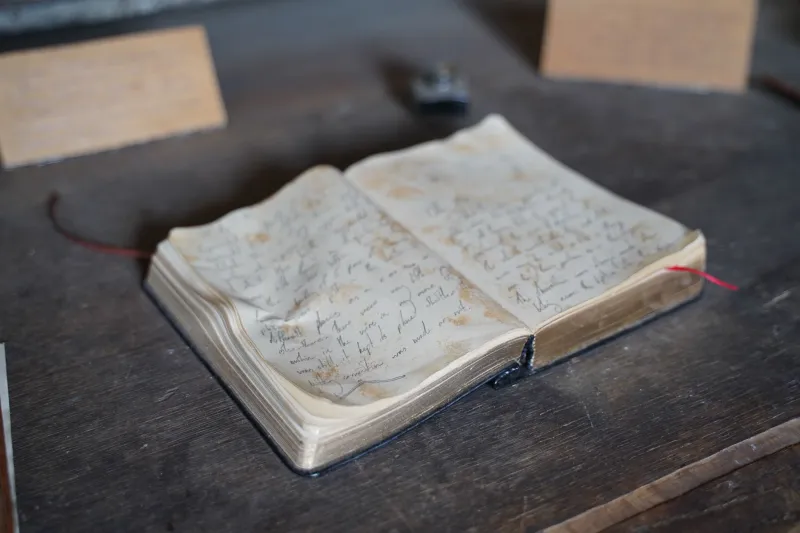
Somewhere in a branch library in Rotherham, a copy of a popular political biography contains, on page 147, a single underlined sentence and, beside it in the margin, three words written in a firm, elderly hand: 'You would say that.' The book has been borrowed forty-one times since its acquisition. The annotation remains. The librarian who processes it each return has long since stopped reaching for the eraser.
This is the underworld of British marginalia — unglamorous, unsolicited, and entirely uncoordinated. Unlike the celebrated annotations of Samuel Taylor Coleridge or the scholarly apparatus of academic readers, the scrawled interventions found in public library books belong to no tradition, claim no authority, and seek no audience. They are, in the truest sense, writing for no one. Which is precisely what makes them so revealing.
The Borrowed Book as Battlefield
To encounter marginalia in a library book is to experience a peculiar intimacy. You are reading not only the author's argument but the residue of someone else's encounter with it — their irritation, their agreement, their grief, their wit. The text becomes, in the language of literary theory, a palimpsest: a surface overwritten by successive hands, none of which entirely obliterates the last.
Britain's public libraries have always been, among other things, repositories of working-class intellectual aspiration. From the mechanics' institutes of the nineteenth century to the Carnegie-funded reading rooms of the early twentieth, the library represented a democratisation of knowledge — the idea that curiosity was not the exclusive province of those who could afford to own books. The annotated library book is, in a sense, the logical extension of that democratic impulse: if the library grants access to the text, the marginal note asserts the right to argue back.
What do these annotations actually say? The range is extraordinary. At one end, there is the pedantic corrector — the reader who circles a grammatical error, draws a line through a misattributed quotation, or writes 'WRONG' beside a factual claim with the quiet fury of someone who has been waiting years for an opportunity to say so. At the other end, there is the emotionally overwhelmed reader who writes simply 'yes' beside a passage about loneliness, or 'this is me' in a self-help chapter on unresolved grief. Between these poles lies every register of human response: the sarcastic, the tender, the politically enraged, the philosophically bewildered.
Generational Fault Lines in Ink
One of the most striking features of library marginalia, when examined across multiple borrowings, is the way it maps generational disagreement. Books on social policy, gender, race, and class — already contested territories — often accumulate annotations that read like a slow-motion argument between readers separated by decades. A passage on immigration policy might carry, in one margin, a 1990s annotation defending multiculturalism in rounded, optimistic handwriting, and, immediately below it in a different ink and a different decade, a curt rejoinder that suggests the first reader was being naïve. Neither reader knew the other existed. Both were certain they were right.
This accidental dialogue is one of the more extraordinary cultural phenomena hiding in plain sight within British civic life. Libraries, institutions we tend to associate with silence and order, are in fact hosting a perpetual, asynchronous argument — one that crosses time, class, and ideology with no moderator and no resolution. The algorithm has nothing to do with it. There is no engagement metric, no reply button, no notification. Just ink, and the possibility that someone else will read it.
What Gets Erased, and Why
Libraries have an official relationship with marginalia: they erase it. Pencil marks are rubbed out during the processing of returns; pen marks, more resistant, are sometimes blacked out or the page repaired. The institutional logic is straightforward — the library's books belong to everyone, and no single reader's commentary should colonise a shared resource. There is something admirable in this position, and something that also quietly grieves.
Because what is lost in that erasing is not merely graffiti. It is evidence. The annotations left in books on feminism during the 1970s and 1980s — the angry agreements, the furious disagreements, the names and dates occasionally scribbled in — constitute a form of oral history rendered in pencil. The marginalia found in books on HIV and AIDS during the epidemic years, in books on Thatcherism, in books on the miners' strike, carries within it a kind of testimonial weight that no official archive quite replicates. These were not considered interventions. They were immediate, unguarded, and entirely human.
The Ideology of the Marginal Note
If the margin is a space of relative freedom — outside the main text, beyond the author's jurisdiction — then what people choose to do with that freedom is revealing. A significant proportion of library annotations are, in essence, acts of resistance to authority. The reader who writes 'this is class bias' beside an economic argument, or 'patronising' beside a passage about working communities, or who draws a large question mark beside a claim presented as self-evident, is doing something politically meaningful, even if they never intended it as such. They are refusing to be a passive recipient of someone else's framing.
This is, of course, what reading at its best has always done — produced active, resistant, critical subjects rather than compliant consumers of text. But the marginal note externalises that resistance, makes it visible, and in doing so transforms the private act of reading into something approaching public discourse. The library book becomes a community noticeboard for ideas that have no other venue.
Talking Back to the Text
There is a particular category of annotation that deserves its own consideration: the rebuttal. Not the correction of a fact, nor the expression of feeling, but the sustained counter-argument — sometimes running across several pages, sometimes cramped into a margin so tightly that it requires a magnifying glass to read — in which a reader takes genuine issue with an author's logic and refuses to let it pass unchallenged.
These are the annotations that most clearly reveal the library book as a site of intellectual democracy. The reader may be a retired schoolteacher in Coventry, a university student in Cardiff, a care worker in Dundee. They have no platform, no credentials, no guarantee that anyone will ever read what they have written. They write anyway. They argue anyway. They refuse, in the quiet of a borrowed book, to be silenced by the authority of print.
That refusal is, in its modest and pencilled way, one of the more dignified expressions of intellectual life that Britain produces. It asks nothing. It expects nothing. It simply insists, against the margins of someone else's certainty, that there is more to be said.