Ink Without Identity: The Anonymous Voices Speaking from Britain's Secondhand Textbooks
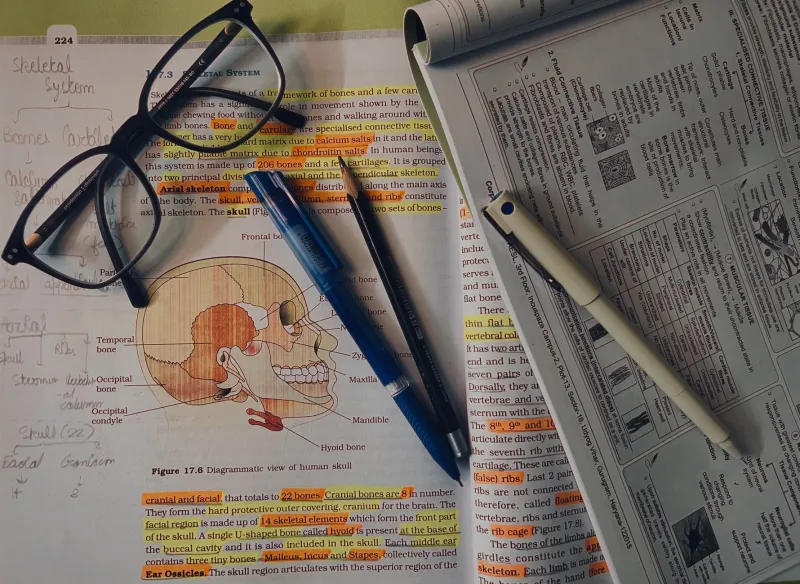
There is a particular kind of reading that happens before the reading begins. You open a secondhand textbook—perhaps a battered copy of Capital acquired from an Oxfam Books in Leeds, or a sociology primer found on eBay listed as 'good condition, some annotations'—and before you reach the first argument, you encounter someone else's. A pencilled question mark beside a theorem. A furious double underline beneath a sentence about colonial administration. A margin note, written in a hand that curves with urgency, that reads simply: is this actually true though??
These are the margin notes nobody signed. And they constitute, in aggregate, one of Britain's most overlooked literary forms.
The Archaeology of the Annotated Page
Secondhand academic books circulate through a peculiar economy. They travel from university bookshops to student bedrooms, from bedroom floors to end-of-term charity donations, from charity shops to online listings, from listings to the next cohort of students, who will sometimes write over the previous owner's marks and sometimes enter into dialogue with them. Each transfer deposits a new sedimentary layer of engagement—or disengagement, which is itself a kind of testimony.
What distinguishes the textbook annotation from the literary marginalia that scholars have long studied—the famous scrawlings of Keats, the combative pencil of Sylvia Plath—is precisely the anonymity and the ordinariness. These are not the marks of writers who suspected posterity might be watching. They are the marks of a second-year economics student in Birmingham who was confused about elasticity at eleven o'clock on a Tuesday night, or a literature undergraduate in Edinburgh who found something in a passage about empire that her seminar tutor had not mentioned and did not know what to do with the feeling.
The confusion is documented. The revelation is documented. Neither was meant to be.
What the Underlinings Argue
Annotations in academic texts tend to cluster in predictable ways, and those patterns are themselves revealing. Passages that appear in examination guidance are often underlined in a mechanical, dutiful fashion—the highlight applied not because the reader was moved but because they were instructed to care. These marks speak of compliance rather than curiosity. They are the textual equivalent of a hand raised not because you have a question but because you have been told that participation is assessed.
But then there are the other marks. The circled words that suggest genuine unfamiliarity—a technical term, certainly, but also sometimes an ordinary word encountered in an unexpected configuration, suggesting a reader for whom the register of academic prose was itself a foreign country. The cross-references scribbled from one chapter to another, evidence of a mind making connections the author had not explicitly invited. The occasional full sentence of response, written in the margins with the compressed urgency of someone who had no one else to tell.
In a copy of a widely used introduction to political philosophy, sold through a well-known online marketplace and originating, by the look of its spine sticker, from a former polytechnic now rebranded as a university, one reader had written beside a passage on social contract theory: My mum would say this is all just common sense but they make it sound like only clever people thought of it. The observation is, philosophically speaking, not without merit. It is also a small window into a classroom dynamic—the gap between inherited wisdom and institutionalised knowledge—that no course handbook would ever acknowledge.
The Cultural Sediment of Academic Struggle
Britain's higher education system has expanded dramatically over the past three decades, drawing in students from backgrounds that the universities were not originally designed to serve. The annotated textbook carries the trace of this expansion in ways that institutional data cannot. Reading comprehension difficulties, the pressure of first-generation student status, the particular exhaustion of studying whilst working—none of these appear in league tables, but some of them appear in the margins.
A medical textbook, its cover worn to the point of illegibility, purchased at a charity shop in a post-industrial town in the north of England, contained throughout its pages a running system of personalised mnemonics—rhymes, acronyms, small drawings—that suggested a student who had found their own route through material that was not yielding to conventional study. There was something quietly heroic about the ingenuity on display. There was also something quietly indicting about the fact that such ingenuity had been necessary at all.
The annotations, in this sense, document not merely individual struggle but systemic pressure. They are the evidence of what happens when people who were not expected to be in certain rooms find themselves in those rooms and must improvise their survival.
Correction as Conversation
Among the most striking annotations are those that argue back. Academic texts are, by convention, authoritative—their assertions presented with a confidence that discourages the reader from dissenting. And yet dissent is precisely what some margins record. Passages are marked wrong or oversimplified or, more diplomatically, but see also— followed by a reference the original author had either overlooked or chosen to exclude.
These corrective annotations are often impossible to verify. The reader may have been right; they may have been mistaken; they may have been operating from a rival theoretical tradition that made their objection internally coherent even if externally contestable. What matters is the impulse itself—the refusal to accept the printed word as final, the insistence on writing back into the silence that academic authority so often demands.
In an era of spiralling tuition fees and the transactional logic they impose upon learning, these argumentative margins feel almost radical. They are evidence that some students, somewhere, were still reading for reasons that had nothing to do with their final grade.
The Accidental Archive
There is no institution that collects these annotations systematically. No archive preserves the marginal literature of Britain's expanding universities. The books circulate until they disintegrate, their annotations fading or being overwritten, their anonymous authors moving on to careers and lives that may or may not have been shaped by the passages they once underlined with such urgency.
This impermanence is part of what makes the form so poignant. The margin note is addressed to no one and yet, by the logic of secondhand circulation, it finds a reader. The student who wrote is this actually true though?? was not writing for an audience. But someone is reading them now. The line has been crossed—between one stranger's uncertainty and another's recognition—and in that crossing, something that might tentatively be called literature has occurred.
Britain's secondhand textbooks are, in the end, a distributed and democratic archive of intellectual life as it is actually lived: uncertain, effortful, occasionally brilliant, and almost entirely unwitnessed. They deserve more attention than the charity shop shelf affords them.