The Carriage of Strangers: What British Train Travel Reveals About the Performance of Solitude
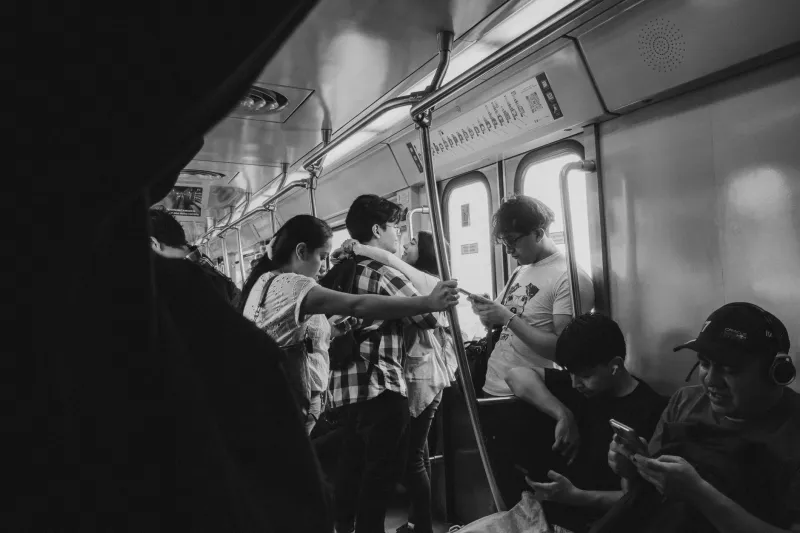
Consider the 07:43 from Guildford to London Waterloo. It is, by any conventional measure, a densely populated space: rows of bodies packed into upholstered seats, shoulders occasionally touching, the shared warmth of too many people breathing the same recycled air. And yet, for the vast majority of its passengers, this carriage might as well be empty. Gazes are directed downward or into screens. Headphones seal individuals into private acoustic worlds. The middle seat remains unoccupied for as long as physically possible, a moat of social deterrence maintained by the placement of a bag, a coat, or simply the weight of communal expectation.
Britain's commuter trains are among the most visually arresting social spaces the country produces, and among the least examined. They deserve to be read as carefully as any gallery installation — because what they stage, every weekday morning and evening, is a performance of extraordinary cultural complexity.
The Architecture of Avoidance
To understand British train behaviour, it helps to think of the carriage not as a functional transport vessel but as a theatrical set — one in which the mise-en-scène has been arranged to facilitate a very specific kind of drama: the performance of solitude in the presence of witnesses.
The props are well established. Headphones — ideally over-ear, visibly substantial — serve as the primary signal of unavailability. They need not even be connected to anything. Their function is semiotic as much as acoustic: they communicate I am not here for you with an efficiency that no spoken declaration could match. The book or newspaper performs a similar function, though with added cultural valence — it suggests not merely absence but purposeful, intellectual absence. The phone, the most democratic of these props, offers the additional advantage of requiring no particular social capital to deploy convincingly.
The physical arrangement of bodies in the carriage is equally choreographed. The window seat is claimed first, placing the maximum possible distance between the occupant and the aisle. The bag on the adjacent seat is a gambit of medium aggression — deniable, easily surrendered under direct pressure, but effective at deterring the casual approach. The deliberate avoidance of eye contact with those entering the carriage is perhaps the most precisely calibrated gesture of all: not rude enough to invite comment, but unmistakably communicative.
A Silence With Strict Rules
What is remarkable about this elaborate non-communication is how rigorously its rules are enforced, and how little they need to be articulated. There is no posted notice instructing passengers to avoid conversation. No authority figure polices the silence. And yet the code is understood with near-universal clarity, breaches are felt as genuine violations, and the social cost of transgressing it — of speaking unprompted to a stranger, of making sustained eye contact, of laughing aloud at something on one's phone — is immediately apparent in the collective flinch of those nearby.
This is a form of collective performance that demands considerable skill from its participants. It requires the ability to inhabit shared space as though alone, to manage the unavoidable physical proximity of other bodies without acknowledging it, and to maintain the fiction of private solitude in a space that is, by definition, public. That most British commuters accomplish this with such apparent ease is not evidence of emotional coldness. It is evidence of sophisticated social training.
Class, Comfort, and the First-Class Partition
The train carriage is also, of course, a space in which class makes itself visible with unusual clarity. The distinction between standard and first class is not merely a matter of seat width or complimentary beverage. It is a spatial articulation of a social hierarchy — the literal partitioning of the population according to the price of their ticket.
First class on a British intercity train carries its own distinct performance culture. The silence here is of a different texture: more assured, less effortful. The passengers in first class are not performing solitude with the same anxious precision as those in standard — they have purchased, along with their seat, a degree of social insulation that their fellow travellers in the adjacent carriage must manufacture through behavioural discipline alone. The headphones here are wireless and expensive. The laptops open to documents rather than streaming services. The performance of purposeful solitude is, in first class, underwritten by economic capital in ways that make it look less like performance and more like natural state.
The quiet coach, that peculiarly British invention, is worth considering in this context. Ostensibly a practical measure, it functions as a kind of aspirational space: a first-class silence available to standard-class ticket holders, provided they comply with its austere social contract. Violations of quiet coach etiquette — the phone call taken, the music audible through headphones — provoke a disproportionate fury that speaks to how much is invested in these small territories of enforced peace.
What We Are Actually Doing
There is a tendency to read Britain's commuter train culture as a symptom of isolation, of a society that has lost the capacity for spontaneous human connection. This reading is not entirely wrong, but it is incomplete. What the train carriage stages is not simply the absence of connection but the active, effortful management of its possibility.
The headphone is not merely a barrier. It is a declaration that the wearer has an inner life worth protecting. The averted gaze is not merely avoidance. It is a form of respect — an acknowledgement that the stranger beside you is also engaged in the business of getting through the day, and has not invited your participation in that project. The elaborate choreography of non-encounter is, in this reading, a kind of collective courtesy: the agreement to leave one another alone, extended to all parties equally.
What this reveals about British identity is not a poverty of feeling but a particular geography of privacy — one in which the self is understood as something to be defended rather than displayed, and in which the most generous thing one can offer a stranger is the gift of being left undisturbed. The train carriage is where this geography is drawn most precisely, its lines as deliberate and as revealing as any work of art.