When Words Become Beats: Literature's Second Life in British Sound
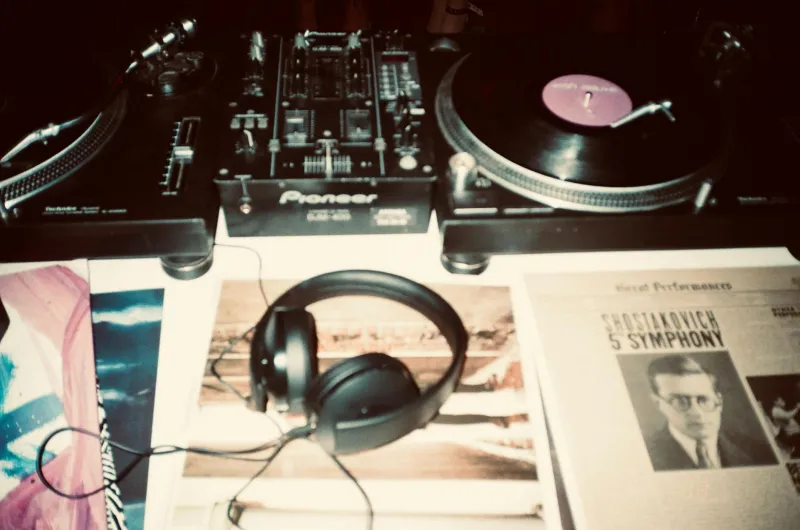
The Archive Awakens
In a cramped South London studio, a producer loops the opening bars of Kate Bush's 'Wuthering Heights' whilst overlaying verses from Stormzy's latest track. This isn't pastiche—it's genealogy. The sonic DNA connecting Bush's 1978 interpretation of Brontë's gothic masterpiece to contemporary British rap reveals something profound about how literature refuses to remain confined to the page.
The phenomenon extends far beyond nostalgic homage. Artists like Akala have spent the better part of two decades demonstrating that Shakespeare's iambic pentameter shares rhythmic DNA with hip-hop's flow, whilst musicians such as Kae Tempest blur the boundaries between spoken word poetry and electronic music so thoroughly that categorisation becomes meaningless. What emerges is not simply music inspired by literature, but a form of cultural translation that interrogates both mediums simultaneously.
Crossing the Textual Divide
This literary-musical hybrid reflects Britain's ongoing conversation with its cultural inheritance. When grime artists sample Dickens or indie bands reconstruct Joyce, they're engaging in what might be termed 'textual archaeology'—excavating meaning from canonical works whilst simultaneously burying them under layers of contemporary context.
Consider Little Simz's recent album, which weaves references to Virginia Woolf through tracks exploring mental health and creative struggle. The juxtaposition isn't accidental; it's argumentative. Woolf's stream-of-consciousness technique finds new expression in Simz's rapid-fire delivery, whilst the historical weight of literary modernism crashes against the immediacy of British urban experience.
The practice extends beyond individual artists to encompass entire movements. The UK drill scene's appropriation of Shakespearean imagery—violence, power, betrayal—reveals how Elizabethan concerns translate disturbingly well to postcode wars and street politics. When young artists in Peckham reference Macbeth's ambition or Hamlet's revenge, they're not displaying cultural capital; they're demonstrating how power structures endure across centuries.
The Democratisation Dilemma
Yet this cross-pollination raises uncomfortable questions about accessibility and authenticity. When classic literature becomes the foundation for chart-topping singles, does it democratise high culture or commodify it? The answer lies somewhere in the tension between preservation and transformation.
Take FKA twigs' incorporation of medieval poetry into her ethereal soundscapes. Her work doesn't simply make ancient texts 'relevant'—it reveals how contemporary experiences of love, loss, and identity echo across temporal boundaries. The medieval becomes modern not through simplification but through sonic sophistication that honours both traditions.
Conversely, when major labels package literary references as marketing hooks—think of the countless indie bands mining Romantic poetry for album titles—the practice risks reducing complex texts to aesthetic flourishes. The line between homage and appropriation becomes particularly fraught when predominantly white, middle-class musicians cherry-pick from diverse literary traditions without engaging with their broader cultural contexts.
Sound and Sense
The most successful literary-musical collaborations recognise that meaning doesn't simply transfer between mediums—it transforms. When Ghostpoet samples Angela Carter's prose over minimalist beats, the result isn't Carter's original meaning plus music; it's an entirely new semantic space where gothic feminism meets contemporary alienation.
This transformation process reveals something crucial about how culture evolves. Literature doesn't die when it becomes music; it mutates, adapts, finds new hosts. The canonical texts that once seemed fixed and authoritative become fluid, responsive to contemporary pressures and possibilities.
The Future Archive
As streaming platforms make musical experimentation more viable and literature more accessible through digital archives, we can expect this cross-pollination to intensify. Young British artists are already creating works that exist simultaneously as songs, poems, and social commentary—defying traditional categorisation whilst expanding the possibilities of both mediums.
The question isn't whether this trend will continue, but how it will evolve. Will future musicians dig deeper into overlooked literary traditions, or will they create entirely new forms that render the literature-music distinction obsolete? Perhaps more importantly, will these collaborations help preserve literary culture for new generations, or will they accelerate its transformation into something unrecognisably different?
What remains certain is that when words become beats, both are forever changed. In the collision between page and stage, verse and chorus, Britain's cultural conversation continues—louder, stranger, and more vital than ever.