The Silent Revolution: When Hands Speak Louder Than Words in Britain's Cultural Renaissance
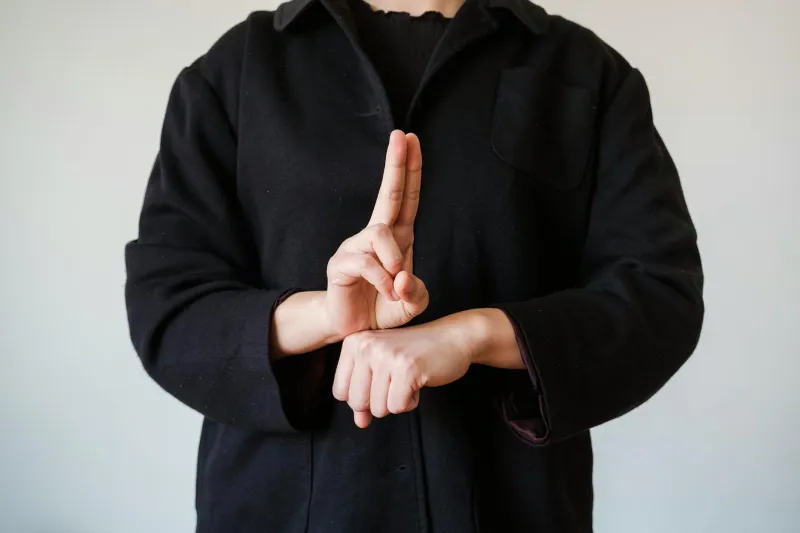
The Language of Liberation
In the hushed corridors of the Tate Modern, something extraordinary unfolds each Tuesday evening. As visitors navigate between towering installations and contemplative canvases, a different kind of performance takes centre stage—one where hands dance through air, crafting meaning from movement, transforming what was once considered mere translation into pure artistic expression.
The recognition of British Sign Language as an official language in April 2022 marked more than a legislative milestone; it heralded a cultural awakening that continues to reverberate through Britain's creative institutions. What emerges is not simply improved access for Deaf audiences, but a fundamental reimagining of how art communicates, challenges, and connects.
Beyond Translation: BSL as Creative Medium
Deaf poet Raymond Antrobus, whose work bridges the auditory and visual realms, articulates this shift with characteristic precision: BSL interpretation in cultural spaces has evolved from accommodation to art form. When interpreters like Sophie Woolley—herself a pioneering figure in British Deaf theatre—translate spoken poetry into sign, they create an entirely new work, one that exists in three dimensions, incorporating facial expression, spatial relationships, and temporal rhythm in ways that spoken language cannot.
This transformation is perhaps most visible in London's Deaf-led theatre companies, where BSL operates not as a secondary language but as the primary creative vehicle. Companies like Deafinitely Theatre have spent decades proving that sign language possesses its own dramatic grammar, its own capacity for metaphor and abstraction. Their recent production of 'Cyrano de Bergerac' demonstrated how BSL's visual nature can convey the play's themes of physical appearance and inner beauty with an immediacy that spoken dialogue struggles to match.
The Gallery Reimagined
Visual arts institutions across Britain are discovering that BSL integration demands more than hiring interpreters for opening nights. The National Gallery's recent collaboration with Deaf artist Christine Sun Kim revealed how galleries must reconsider their fundamental assumptions about how art communicates. Kim's sound installations, experienced through vibration and visual representation rather than auditory sensation, challenged visitors to engage with artistic meaning through alternative sensory pathways.
This shift extends beyond individual artworks to encompass entire exhibition strategies. The Whitechapel Gallery's groundbreaking 'Silent Voices' exhibition featured QR codes linking to BSL interpretations of wall texts, but more significantly, it commissioned Deaf artists to create responses to historical works, generating conversations between past and present that transcended linguistic boundaries.
The Theatre of Gesture
Britain's theatrical landscape reveals perhaps the most dramatic transformation. The Royal Shakespeare Company's recent commitment to integrate BSL into mainstream productions represents more than inclusive casting; it acknowledges sign language's inherent theatricality. When Deaf actor Rose Ayling-Ellis performed Lady Macbeth's sleepwalking scene in BSL, critics noted how her hand movements created visual echoes of washing motions, adding layers of meaning unavailable to spoken performance.
This integration challenges traditional notions of theatrical hierarchy. In BSL-integrated productions, the interpreter becomes co-creator, their positioning and movement integral to the production's visual composition. Directors must consider sightlines not merely for spoken dialogue but for the geometric poetry of sign language, transforming stage design from acoustic to visual architecture.
Cultural Crossroads
The intersection of Deaf culture and mainstream British arts reveals profound questions about cultural ownership and artistic authenticity. When hearing artists incorporate BSL elements into their work, debates emerge about appropriation versus appreciation, similar to discussions surrounding other cultural practices. Yet Deaf artists like Aaron Williamson argue that these tensions generate productive friction, forcing both communities to examine their assumptions about artistic expression and cultural boundaries.
Young Deaf artists emerging from institutions like the Royal College of Art bring fresh perspectives to these conversations. Their work often explores the liminal space between hearing and Deaf worlds, creating art that requires no translation because it speaks in purely visual vocabularies. These artists challenge the notion that BSL serves merely as a bridge to hearing culture; instead, they position it as a destination in itself.
The Sound of Silence
Perhaps most significantly, BSL's integration into British cultural life forces a reconsideration of silence itself. In a culture obsessed with noise—from London's constant urban soundtrack to the chatter of gallery openings—Deaf artists offer alternative ways of experiencing and creating meaning. Their work suggests that silence is not absence but presence, not limitation but liberation.
The National Theatre's recent 'Quiet Volume' series exemplified this shift, featuring performances where silence became a creative medium rather than a barrier to overcome. Audiences reported heightened visual awareness, increased attention to physical expression, and deeper engagement with non-verbal communication.
Future Frequencies
As British cultural institutions continue integrating BSL into their programming, questions emerge about the future of artistic expression in an increasingly connected yet divided society. Will sign language's visual nature offer new forms of international artistic communication? How might digital platforms amplify or constrain BSL's three-dimensional artistry?
What remains clear is that BSL's recognition has unleashed creative possibilities that extend far beyond accessibility compliance. Britain's cultural landscape is discovering that when hands speak, they often say things that voices cannot—creating art that exists not despite language barriers but because of the rich possibilities found in crossing those lines.