Silent Dialogues: How British Cinema Lost Its Voice to the Written Word
The Quiet Revolution
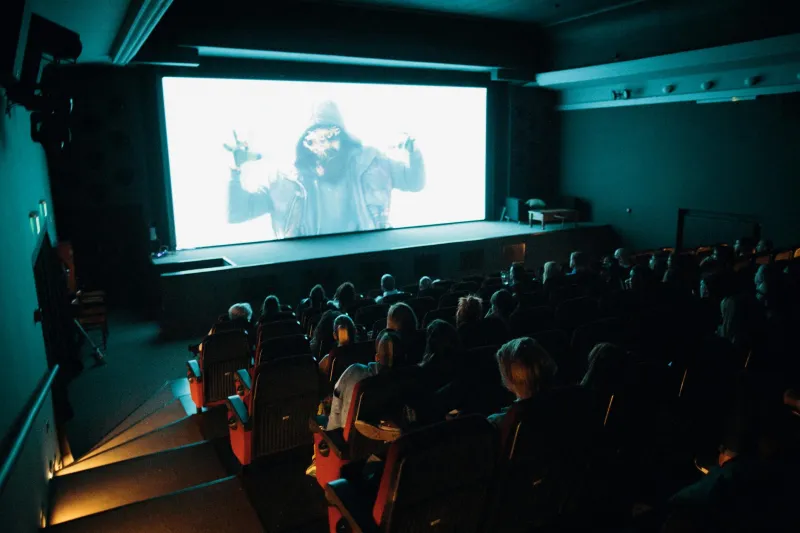
In darkened cinemas across Britain, a peculiar phenomenon unfolds nightly. Audiences settle into their seats, eyes fixed not solely on the visual narrative unfolding before them, but simultaneously tracking the white text scrolling beneath. This isn't foreign cinema requiring translation—these are British films, British voices, British stories being consumed through an increasingly visual medium of comprehension.
The statistics paint a stark picture of this cultural shift. Recent surveys indicate that over 60% of streaming viewers under thirty-five routinely enable subtitles for English-language content, whilst cinema chains report growing requests for subtitled screenings of domestic productions. What was once the domain of accessibility provisions has become mainstream viewing preference, suggesting something fundamental has altered in how we process spoken narrative.
The Fractured Soundscape
Sound designer Margaret Thornfield, whose work spans from Ken Loach's social realism to Christopher Nolan's sonic bombast, identifies multiple culprits behind this auditory retreat. "Contemporary British filmmaking has embraced a kind of acoustic authenticity that prioritises naturalism over clarity," she explains. "Directors want actors to speak as they would in real life—mumbled, overlapping, regionally inflected. The problem is real life doesn't come with volume controls."
This pursuit of verisimilitude has created an unintended barrier. The very regional accents that define British cultural identity—from Glaswegian to Geordie, from Scouse to Somerset—have become obstacles rather than assets in contemporary storytelling. Where once received pronunciation provided a standardised delivery mechanism, today's commitment to authentic representation has fragmented the sonic landscape into a patchwork of regional dialects that younger, increasingly cosmopolitan audiences struggle to decode.
Technology's Double Edge
The proliferation of personal devices has fundamentally altered our relationship with audio. Dr James Whitmore, who researches digital media consumption at the University of Edinburgh, notes that "an entire generation has grown accustomed to consuming content in environments where audio clarity is compromised—on trains, in cafés, through poor-quality earbuds. Subtitles have become a technological crutch that's evolved into a preference."
This technological mediation extends beyond mere convenience. The rise of social media platforms where videos autoplay without sound has conditioned viewers to expect visual text accompaniment. TikTok, Instagram, and YouTube have created a generation of consumers who instinctively look downward for textual confirmation of what they're hearing above.
The Accessibility Imperative
Yet beneath these technological and aesthetic explanations lies a more profound cultural shift towards inclusivity. Sarah Chen, accessibility coordinator for the British Film Institute, argues that widespread subtitle adoption represents "an unconscious embrace of universal design principles. When subtitles become normalised rather than othered, we create viewing experiences that work for everyone—the deaf and hard-of-hearing community, certainly, but also non-native speakers, those with auditory processing differences, and viewers in noisy environments."
This democratisation of access challenges traditional hierarchies of sensory experience in cinema. The spoken word, long privileged as the primary vehicle for narrative exposition and character development, must now compete with its visual representation for primacy. In this competition, text often wins—it's precise, reviewable, and immune to the acoustic variables that plague spoken dialogue.
Regional Resistance and Cultural Loss
Dialect coach Patricia Moorhouse, who has worked with actors from Ewan McGregor to Thandiwe Newton, expresses concern about this textual turn. "There's something irreplaceable about the musicality of regional speech—the rhythm, the emotional undertones, the cultural specificity that can't be captured in Times New Roman font," she argues. "When we reduce that to text, we're losing essential elements of British cultural expression."
This concern extends beyond aesthetics to questions of cultural preservation. If audiences increasingly rely on subtitles to understand their own linguistic heritage, what happens to the subtle regional variations that have historically defined British identity? The flattening effect of standardised text threatens to homogenise the rich dialectal diversity that filmmakers ostensibly seek to celebrate.
The Future of British Storytelling
As British cinema navigates this acoustic crossroads, fundamental questions emerge about the nature of cinematic communication. Are we witnessing the birth of a new hybrid medium where visual and textual elements carry equal narrative weight? Or are we observing the gradual diminishment of spoken language's power to convey meaning?
The answer likely lies somewhere between these extremes. Contemporary British filmmakers must grapple with audiences who demand both authentic representation and accessible consumption. This tension—between cultural specificity and universal comprehension—reflects broader challenges facing British society as it negotiates between preserving local identity and embracing global connectivity.
Reading the Room
The subtitle phenomenon reveals deeper truths about contemporary British culture than mere viewing preferences. It suggests a society increasingly comfortable with mediated experience, where direct sensory engagement gives way to technologically filtered consumption. Whether this represents evolution or loss depends largely on perspective, but its implications for British storytelling are undeniable.
As audiences continue choosing text over voice, filmmakers face a crucial decision: adapt their acoustic approach to reclaim auditory attention, or embrace this new visual literacy as an expanded canvas for narrative expression. In either case, the relationship between word and image in British cinema has fundamentally shifted, creating new possibilities and challenges for how stories are told and consumed in an increasingly connected yet acoustically fragmented world.